Showing posts with label Turbo. Show all posts

2010 Porsche 911 Turbo Next Generation Sports Cars At The Frankfurt Motor Show


2010 Porsche 911 Turbo

The next generation Porsche 911 Turbo, Porsche is proud to present a new top model at the pinnacle of its broad range of production sports cars.All key features of this high-performance sports car have been improved significantly and combine far-reaching technical innovations with supreme refinement. As a consequence, the new 911 Turbo offers increased performance, lower weight, enhanced driving dynamics and greater fuel efficiency.With respect to dynamic performance and fuel economy in particular, the next generation Porsche 911 Turbo now stands apart from its competitors even more. The new model will be presented to the public for the first time at the Frankfurt Motor Show from 17 - 27 September, 2009.
2010 Porsche 911 Turbo
The heart and highlight of the seventh generation Porsche 911 Turbo is the new power unit displacing 3.8-litres and delivering maximum output of 500 hp (368 kW). The first entirely new engine in the 35 year history of the Turbo comes with features such as Direct Fuel Injection and twin turbochargers with variable turbine geometry, the latter attribute being unique to Porsche on a petrol engine.
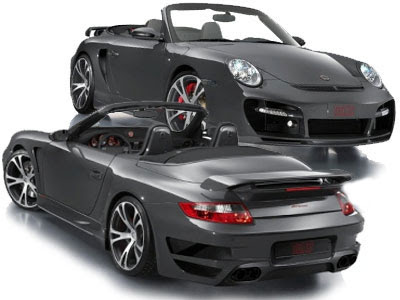
2010 Porsche 911 Turbo
The new six-cylinder engine can be combined with the option of the seven-speed Porsche Doppelkupplungsgetriebe (PDK) double-clutch gearbox; and, for the first time, a further new feature of race car-inspired paddle-shift technology can also be specified. Fitted firmly on the steering wheel, the right paddle is for shifting up through the gears, and the left paddle for shifting down. In conjunction with the optional Sport Chrono Package Turbo, both the paddle-shift steering wheel and the PDK steering wheel with its shift buttons feature integrated displays for Launch Control and the Sport/Sport Plus mode.
This unique combination of supreme technical features ensures an unprecedented standard of responsiveness, agility, performance and efficiency. For example, the new Porsche 911 Turbo reduces CO2 emissions versus its predecessor by almost 18 per cent and therefore ranks unique in its segment in this respect also.
2010 Porsche 911 Turbo
Depending on the configuration of the car, the new 911 Turbo offers fuel consumption ranging between 24.1 - 24.8 mpg (equal to 11.7 - 11.4 litres/100 km) under the EU5 standard. This is all the more remarkable considering the potential for the Porsche 911 Turbo to accelerate from 0-62mph (100 km/h) in 3.4 secs. Top speed, in turn, is 194 mph (312 km/h.)
Owners of the new Porsche 911 Turbo will also enjoy a further improvement in driving dynamics, with detailed enhancement of the Porsche Traction Management (PTM) fully-controlled all-wheel drive and Porsche Stability Management (PSM) being further supported by the new option of Porsche Torque Vectoring (PTV).
2010 Porsche 911 Turbo
Porsche Torque Vectoring makes the car even more agile and precise in its steering responses, particularly on twisting roads.The next generation Porsche 911 Turbo Coupé and Cabriolet go on sale in the UK and Ireland on November 21 2009, priced from £101,823 for the Coupé and £109,048 for the Cabriolet. Standard equipment includes the touch-screen Porsche Communication Management system with both Bluetooth mobile telephone and i-Pod connectivity. Also fitted to every 911 Turbo is a Porsche Vehicle Tracking System (VTS), a sophisticated vehicle security package approved to Thatcham Category 5 standard.
2010 Porsche 911 Turbo
Customers will also be able to explore the dynamic attributes of the new 911 Turbo, and develop their own skills behind the wheel, courtesy of a Driving Experience Programme at the Porsche Experience Centre at Silverstone.
SpeedART Turbo Porsche Panamera Sports Car Saloon 4.8 liter twin turbo V8 Engine.


German tuner and Porsche specialist SpeedART celibrates its 10th birthday. As a celebration they have created an exhaust package for the Porsche Panamera Turbo.The PS9 package for the German sports saloon ups the ante with numerous aero add-ons and a bevy of performance upgrades. The Sport-Abgas system provides your Panamera with a more raw sound and twenty extra horses.
The Essen Motor Show, which runs from November 28 to December 6 and is best described as Europe’s answer to SEMA, will see Porsche tuning shop, SpeedART, revealing its take on the Panamera.

The kit brings the total output to 520bhp. The sprint of the 4.8 liter twin turbo V8 will probably be hit the 4.0 seconds. Top speed will not increase a lot but 303km/h (190mph) isn’t too bad for a four-door sedan.Set to be officially unveiled at the Essen Motor Show, the range topping PS9 features 650 hp and 890 Nm of torque thanks to bigger turbochargers, a sport exhaust system (with a sound switch), a sport catalyst, and a revised ECU. These changes enable the car to accelerate from 0-62 mph in 3.5 seconds, before hitting a top speed in excess of 200 mph. If 650 hp is too hot to handle, the company also offers more modest performance packages that allow the engine to produce 550 and 600 hp.SpeedART claims that the most powerful version of the car accelerates from zero to 100km/h (62mph) in 3.5 seconds and goes on to achieve a top speed in excess of 320km/h or 200mph.


In terms of styling, the PS9 is outfitted with an aerodynamic body kit which consists of a front chin spoiler, hood vents, a rear diffuser, a roof spoiler, a modified rear bumper (with air outlets), and aggressive side skirts. Other design details include 22-inch three-piece 'LSC FORGED' wheels and the aforementioned sport exhaust system (available in polished stainless steel or matt black).Inside, the cockpit will get a SpeedART steering wheel with F1-shift paddles, real carbon-fiber trim and accents, new leather upholstery with colored stitches and a revised instrument panel.At the back, we see a new bumper, and the trapezoidal exhaust pipes. A new rear spoiler will also be mounted.

For the interior, SpeedART added a sport steering wheel with F1-shift paddles (which can be outfitted with aluminum-, wood- or carbon fiber inlays), carbon fiber trim, contrast stitching on the door panels and seats, revised instrument dials, and exclusive floor mats.

New Porsche Cayenne: Momentum Launch


A first time SUV for Porsche AG, the Cayenne has been a delightful success for the most profitable automaker in the world. More than 150,000 units have found affluent owners around the globe after rolling off the production line in Leipzig, Germany since 2002. The all-terrain sports car had indeed set many benchmarks for the segment and the second-generation model is expected to carry on the momentum of its predecessor with greater efficiency. What is certain is that the new Cayenne will definitely push the boundaries set earlier and raise the benchmarks once again. Indeed even in its earlier incarnations, it has surpassed the 1st generation BMW X5 in on-road performance, yet at the same time as capable as a Land Rover off-road.

The much awaited 2nd generation Porsche Cayenne was launched to a crowd of around 300 media and guests at the Cayenne Pavillion of the Bukit Kiara Equestrian and Country Resort on Friday 9th March 2007. Guests were treated to a spectacular launch sequence flagged off by race-horses run to highlight the model’s theme: Momentum. The launch at the resort also provided an outdoor and airy feel that was in keeping with the spirit of the new model. This was also to link the dynamism of horses and the adventurous sporting environment like polo, horse racing or even taming the wild outdoors on horseback, with the new Cayenne.


For this 2nd generation Porsche Cayenne, many enhancements - mostly under the skin - will bring it to the forefront of SUV technology. Most significant new feature across the new Cayenne range is DFI or Direct Fuel Injection which enables more power but with improved fuel efficiency! It is quite amazing that the new Cayenne models have increased engine capacities (V6 up from 3.2L to 3.6L, S and Turbo up from 4.5L to 4.8L), more power (V6 up from 250bhp to 290bhp, S up from 340bhp to 385bhp, Turbo up from 450bhp to 500bhp) and yet have lower fuel consumption. Truly engineering advancements: higher performance, less fuel consumption.

Living up to Porsche's sporting heritage and badge, the new Cayenne promises to drive more like sports cars. Thanks largely to the new optional PDCC and standard ‘Sport’ button found in all models. PDCC is short for Porsche Dynamic Chassis Control, which actively limits body roll in bends and balances out the car’s angle under nearly all driving conditions (following braking, steering inputs and take-off). Body movements are therefore minimized during even spirited drives, with the sporty Cayenne able to corner almost flat during such outings. The ‘Sport’ button allows for a more sporting and dynamic drive for models equipped with the Tiptronic S automatic transmission and PASM (Porsche Active Suspension Management).

The most obvious change is to the exterior and the new Cayenne sports a more dynamic and distinctive front view thanks to a new slimmer headlight design, enlarged front air inlets, re-positioned fog lights and more contoured front shoulders.

At the rear, the new LED taillights add to the enhanced visual appeal together with a redesigned bumper with a diffuser and tail pipes in the lower apron.

The roofline is also lengthened with clever use of a new rear spoiler. All these styling enhancements not only serve to give the New Cayenne it’s distinctive arresting visual appearance but also bring in greater aerodynamic efficiency.

The new Cayenne is available now at Porsche Centre Glenmarie, Kuala Lumpur and Penang. Prices start at RM650K for the base Cayenne, RM765K for the Cayenne S and a cool RM1.1million for the Cayenne Turbo. All prices are quoted with the 6-speed Tiptronic S gearbox, without insurance.

Related Post:

New 2007 Porsche Cayenne in Malaysia


By Dr Long


Spotted at Porsche Centre Glenmarie in Malaysia recently, were the new 2007 model Porsche Cayenne, Cayenne S and Cayenne Turbo parked in Auto Eurokars’ stockyard. The changes seen are quite subtle with no drastic changes made by Porsche. After all, the Cayenne has been a healthy profit-making model for the high performance automaker since its late 2002 debut. As such, the newer design is more evolutionary than revolutionary, although the facelift has certainly made them sleeker. One of the sportiest of SUV around, the new Cayenne cuts a lither and more modern figure now.

Definitely more refreshing are the slimmer headlamps and the re-sculpted taillights. A wider and lower stance – as visible from the front - has been afforded by the more protruding flanks, flatter headlights, wider-extending air dams and aerodynamic front fascia. Other notable changes are a pair turning/parking lamps now tucked vertically (except for Cayenne Turbo) into the bilateral gaping grilles of the front bumper. Less obvious but sportier now are details such as the dual exhaust tips now jutting out through ovoid openings in the rear bumper, plus what appears to be a posterior lower air diffuser. The new Cayenne now looks even more like a high-riding 996/997, especially for the Cayenne Turbo.

Under the hood, even the base Cayenne gets a healthy +40bhp of power boost. Its normally aspirated (N/A) six-cylinder engine sees an increase in cubic capacity from 3.2 to 3.6L, enabling it to churn out 290bhp and 385Nm. 0-100km/h is in a claimed 8.1secs, before topping out at 227km/h.

One rung up is the Cayenne S, powered by a 4.8L N/A V8 VarioCam Plus powerplant capable of 385bhp (previously 340bhp) and a bolt-wrenching 500Nm of torque (up from 420Nm). Century sprint is achieved in 6.6secs and this S variant will nudge 252km/h at full pelt.

The ‘bad-boy’ of the family must be the Cayenne Turbo. Its Bi-Turbo VarioCam Plus 4.8L V8 motor now punches out 500bhp (previously 450bhp) and 700Nm (620Nm before). It will shoot from standstill to 100km/h in 5.1secs, on its way to a Vmax of 275km/h.

All Cayennes have permanent 4WD system dubbed Porsche Traction Management (PTM). Torque distribution is 38% front and 62% rear with electronically controlled centre differential. Enhanced Porsche Stability Management (PSM) – electronic stability program equivalent - is standard on all new Cayennes while Porsche Active Suspension Management (PASM) – adjustable air suspension system - is only standard on the Cayenne Turbo. New bi-xenon headlamps with dynamic cornering light are also fitted standard on the Turbo but a paying option for the others.

Prices are expected to start from RM650K, marginally cheaper than the pre-facelift ‘predecessors’. The new 2007 Cayenne will be available at Auto Eurokars’ Porsche Centre Glenmarie showroom from March 10 onwards.

Saab 9-3 SportCombi 2.0 LPT Sport+


By Dr Long


SportCombi is Saab’s lingo for stationwagon or estate version. Launched in 2006 by Auto Eurokars in Malaysia, the 9-3 SportCombi is an athletic and sporty looking wagon.

Somehow, this bootless version appeared sleeker than its sedan brethren, looking much like an extended hatchback, rather than a utilitarian estate.
Notable features include an all aluminium hatch, passive rear-wheel steering and frosted rear lamps cover. Another creative innovation is the flat cargo bed which can be folded to form a partition. Great for packing stuffs in the rear and not have them flung about! At the centre of this same floor board, an aeroplane-shaped handle - made of brushed aluminium alloy - really catches the eye. Lift this and pull up the hard board completely, a space saving subwoofer is mounted just underneath. In IKEA fashion, this 10” speaker with its housing fits nicely into the spare wheel. Overall audio performance is however just adequate.

Suprisingly too, this estate drove nicer than the sedan, despite sharing the same floorpan (wheelbase et al), engine and transmission. It was very pleasant to go around corners albeit with that little FWD tendency to understeer. Interestingly, this 9-3 variant felt well put together with that stronger ‘cocoon’ bodyshell. As such, it is reckoned that suspension damping - and thus ride comfort - is improved too, as a result of a stiffer body structure. There is just that appreciable bit more of ride pliancy than the 9-3 sedan. Or could it be that the dampers or suspension load ratings is different for this wagon (seeing that it is heavier than the saloon)?

The turbo spools pretty quickly to give a maximum output of 195bhp @ 5,620rpm. Hardly any lag and you could feel an addictive ‘charged’ power band stretching from 2500rpm onwards. Nicely responsive and torquey in response to a heavier right foot. Torque peaks at 310Nm from a low 2000rpm, and stays constant all the way 5000rpm! Braking performance cannot be faulted, for this is a car capable of 230km/h and a century sprint figures of 8.8 seconds. Despite all these petrol-head’s indulgence, in-cabin serenity, comfort and general NVH refinements are not an issue. Saab’s 5-speed Sentronic auto tranny is fuss-free. Well, the gearbox maybe just a little slow in engaging (manual mode) upshifts during hard acceleration but still no jerks or drama here.

High speed stability though is a little lacking. Doing upper-range triple digits on a deserted expressway, the test car felt ‘floaty’ and even a little jittery at the rear axle. Conversely though, tackling bends with Saab's ReAxs passive rear-wheel steering, this 2.0T Sport+ wagon is quite well behaved, provided throttle input is metered nice and smooth.

In conclusion, the 9-3 SportsCombi is a viable alternative to mainstream uber-wagons from the other famed Swedish automaker and even that few Teutonic Touring models. A pleasant all-round family wagon, this Saab truly deserves a second look for those looking for practicality, space, comfort and perhaps, a different kind of exclusivity.


Car New Mode Copyright © 2008 D'Black by Ipiet's Blogger Template