Showing posts with label V10. Show all posts

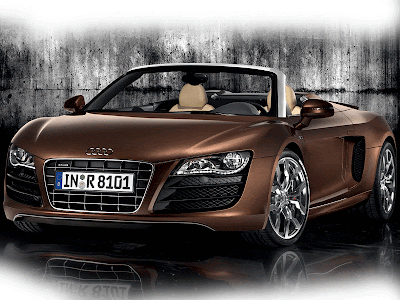
2010 Audi R8 Spyder 5.2 FSI quattro V10 engine


2010 Audi R8 Spyder 5.2 FSI quattro V10 engine

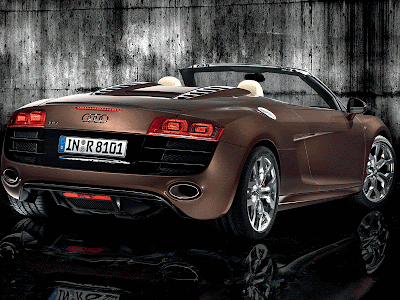
While everybody and their brother likes the R8, there is a small, but vocal minority that's always thought coupe looked a little funny. Well, that group of naysayers can now put a sock in it, as the R8 Spyder is simply gorgeous. Gone are the carbon fiber side blades, in are sensible but somehow better looking slab sides. Regardless, it's simply hot. Exceptional performance and breathtaking dynamism coupled with the intense sensations of open-top driving: Audi presents the R8 Spyder 5.2 FSI quattro. Its lightweight cloth top opens and closes fully automatically; several body parts are made of a carbon fiber composite material.
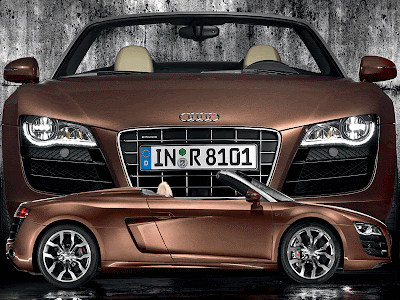
2010 Audi R8 Spyder 5.2 FSI quattro V10 engine

The V10 engine produces 386 kW (525 hp) and launches the open-top two-seater to 100 km/h (62.14 mph) in 4.1 seconds; 0 – 200 km/h (124.27 mph) in 12.7 seconds; on its way to a top speed of 313 km/h (194.49 mph) with the six-speed manual transmission. The 5.2-liter engine features FSI direct fuel injection. Equipped with a manual transmission, the R8 Spyder 5.2 FSI quattro consumes an average of 14.9 liters of fuel per 100 km (15.79 US mpg) – a good figure given its power. With R tronic, this figure improves to 13.9 liters (16.92 US mpg). Featuring technologies such as the Audi Space Frame (ASF), quattro permanent all-wheel drive, full-LED headlights and with an innovative seatbelt microphone available as an option, the R8 Spyder 5.2 FSI quattro is the new top-of-the-range Audi.
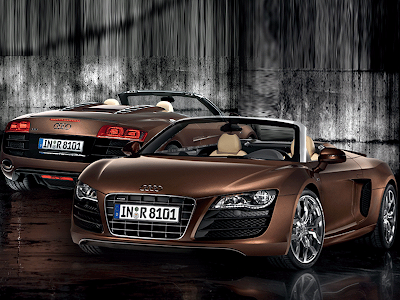
2010 Audi R8 Spyder 5.2 FSI quattro V10 engine

Unlike the Coupé, the Spyder does not have sideblades behind the doors. The side panels and the large cover over the storage compartment for the cloth top are made of a carbon fiber composite. Two arched cowls, which extend to the spoiler lip and include large, integrated air vents, give the rear of the open-top two-seater a powerful profile.
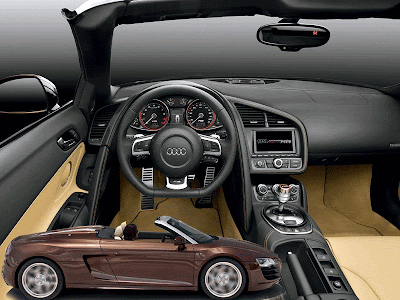
2010 Audi R8 Spyder 5.2 FSI quattro V10 engine

The electrohydraulic soft top opens and closes in 19 seconds, even while driving at speeds up to 50 km/h (31.07 mph). When opened, it folds like a Z into its storage compartment over the V10 engine. The compartment cover opens and closes automatically. The heated glass window, which is separate from the cloth top, is lowered into the bulkhead. It can be independently raised and lowered at the press of a switch, with the top up or down. Audi offers the R8 Spyder 5.2 FSI quattro with a choice of three colors for the top. The body is available in eleven paint finishes, with metallic and pearl effect finishes standard. The windshield frame is coated with anodized aluminum. The leather for the seats are colored with pigments that reflect the infrared component of sunlight, which keeps the seats up to 20 degrees Celsius (68 degrees Fahrenheit) cooler.
2010 Audi R8 Spyder 5.2 FSI quattro V10 engine

A worldwide first is the optional seatbelt microphone for the hands-free unit, which makes it possible to talk on the phone even with the top down on the highway. Three small, flat microphones are integrated into both seatbelts. At least one of them is ideally positioned relative to the speaker when the belt is on. There is a fourth microphone in the windshield frame. 
2010 Audi R8 Spyder 5.2 FSI quattro V10 engine

The quattro permanent all-wheel drive features a central viscous coupling and distributes power to all four wheels with a heavy rear bias. It works together with the locking differential on the rear axle to provide significantly greater traction, stability, cornering speed and precision. It is the superior technology – in particular for a high-performance sports car.
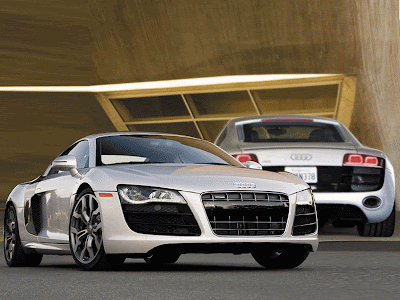
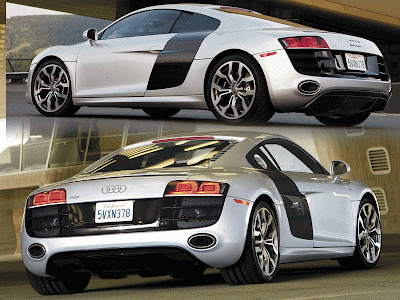
2010 Audi R8 V10 5.2 FSI quattro high-performance Sports Car


2010 Audi R8 V10 5.2 FSI quattro

Audi announced that the price for the highly anticipated 2010 Audi R8 5.2 FSI quattro V10 sports car will be rolled out in Germany in the second quarter of 2009 at a basic price of EUR 142,400. The Audi R8 V10 is the result of cumulative know-how from Audi's string of Le Mans victories. Its naturally aspirated engine combines racing technology such as dry sump lubrication with FSI gasoline direct injection. The ten-cylinder design is the perfect synthesis for impressive top performance, mighty pulling power, and low weight. Starting in 2009, this engine will also prove its potential on the world's racetracks - in the new Audi R8 GT3 racing car Audi is developing for customer teams in conformance with the GT3 rules.
2010 Audi R8 V10 5.2 FSI quattro

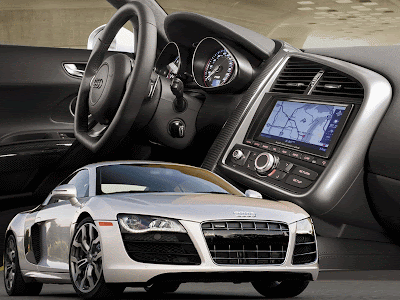
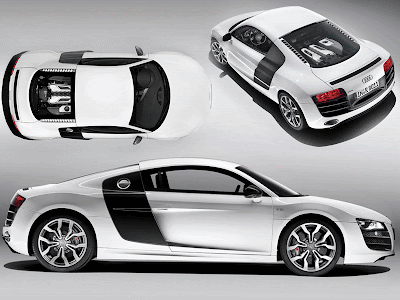
Audi R8 V10 5.2 FSI quattro is the next variant of its top-of-the-line model. With the Audi R8, the brand has established itself at the forefront of high-end sports cars from the very start - and now comes the Audi R8 V10. Its 5.2-liter, ten-cylinder engine churns out 386 kW (525 hp) and 530 Nm (390.91 lb-ft) of torque, which makes for breathtaking performance. With superior Audi technologies such as quattro all-wheel drive, the lightweight aluminum body, the innovative all-LED headlights, and its striking design, the Audi R8 V10 takes pole position against the competition.
2010 Audi R8 V10 5.2 FSI quattro

The V10 engine in the production sports car will be almost identical in construction to the one in the racing version. Its displacement is 5,204 cc, at 6,500 rpm it delivers 530 Nm (390.91 lb-ft) of torque, at 8,000 rpm its power tops out at 386 kW (525 hp). The specific power output is 100.9 hp per liter of displacement - and each hp has to propel only 3.09 kilograms (6.91 lb) of weight, because the Audi R8 V10 in the version with the six-speed manual gearshift weighs only 1,620 kilograms (3571 lb). The engine accounts for 258 of these kilograms (569 lb) - that's only 31 kilos (68 lb) more than the V8.
2010 Audi R8 V10 5.2 FSI quattro

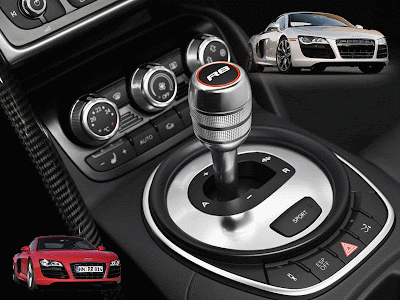
The 5.2-liter powerplant uses direct injection according to the FSI principle developed by Audi. The Audi R8 V10 with R tronic gets by on an average of 13.7 liters per 100 km (17.17 US mpg). The Audi R8 V10 5.2 FSI quattro rockets from zero to 100 km/h (62.14 mph) in 3.9 seconds. In the version with the sequentially shifting R tronic it reaches 200 km/h (124.27 mph) in another 8.1 seconds. Even then its propulsive power hardly lessens: it's sufficient to reach a top speed of 316 km/h (196.35 mph). The immense force, the spontaneity and the thrust of the acceleration, plus the sound of the engine - all these impressions coalesce into a breathtaking sports car experience. The V10 plays a concert with growling bass tones and powerful high notes, which grows into a grandiose fortissimo as the engine revs up. This sonorous acceleration doesn't reach its limit until 8,700 rpm.
2010 Audi R8 V10 5.2 FSI quattro

A contributing factor to the wide lead in traction and driving safety of the Audi R8 V10 over the competition is quattro all-wheel drive - it's the superior technology especially for a high-performance sports car. Four powered wheels get more grip than two. They enable the driver to step on the gas sooner when coming out of a curve. It's not only the traction that benefits, but also the transverse dynamics and the stability.
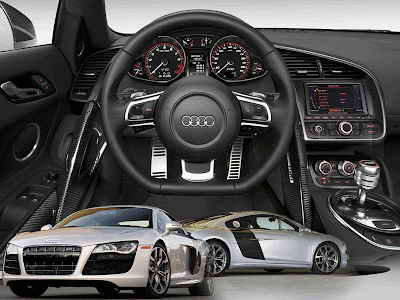
 2010 Audi R8 V10 5.2 FSI quattro

2011 Lotus Esprit Sports Car will be a wholly different Beast powered by a 4.4 liter V8 engine


2011 Lotus Esprit Sports Car

The guys over at AutoCar have caught the upcoming Lotus Esprit testing in cold-snowy weather of Sweden. After running some DVLA records and matching the license plate, AutoCar has learned that the prototype is powered by a 4.4 liter V8 engine. Lotus sources have previously said that BMW may be the supplier for Lotus’ 2011 Esprit.It’s possible that the new Lotus Esprit will carry the 4.4 liter twin-turbo V8 engine from the new BMW X6, but will most likely be tuned to develop 500 horsepower.Currently the 4.4 liter twin-turbo from V8 produces 400 horsepower. The engine is also expected to be used in other BMW models including the X5 and the 7-Series. Lotus engineers will most probably re-work the engine management to reach numbers closer the Nissan GT-R and the Porsche 911 Turbo.
According to Lotus insiders, the next-gen Elise will arrive sometime in early 2011 followed by an all-new V8-powered Esprit in 2012...............................2011 Lotus Esprit Sports Car

The 2011 Elise will likely be built upon an evolved version of the current model’s extruded-aluminium underpinnings and continue the same formula that’s made the pint-sized sportscar a track day fave, but the Esprit will be a wholly different beast.
While the new Elise is all but locked in, the Esprit project is very much dependent on whether Lotus can sell enough Evoras to fund it. The timeline for the Esprit is also at the mercy of the global economic situation, with Lotus likely to delay the Esprit and forge ahead with a far less costly drop-top Evora if the recession persists much longer.
If it launches on time, the Esprit could be Lotus’ best hope of gaining a much larger share of the sports car market.
There are speculations stating that the 500bhp V10 powerplant can be the source of power for the Lotus Esprit, which will be released in 2012...............................2011 Lotus Esprit Sports Car

The engine is currently being used in the Lexus LF-A, a car that has not yet been launched itself. Being connected with the Japanese carmaker Toyota, Lotus has access to its entire range of parts and components, as well as powerplants from the Lexus line. This points to the likelihood of an Esprit flagship, costing more than ?100,000, equipped with the compact 8500rpm V10 unit (to rival the Lamborghini Gallardo), including a less expensive variant equipped with the 5-liter, 417bhp V8 from the Lexus IS-F and an entry-level model coming with a Lotus-tuned direct-injection Toyota V6 unit that can come up with 300bhp.
Although a V8 or a V10 unit would definitely boost the profile of Lotus, there is also a possibility of an Eco Esprit. Lotus is moving forwards with more efficient products with lightweight engineering and its keen interest in alternative fuels and hybrid solutions. This is also underline by its partnership with the electric car manufacturer Tesla...............................2011 Lotus Esprit Sports Car

The Esprit was inspired by the larger bonded and extruded aluminum chassis of the recently launched Evora, the rear section of which have been developed to accommodate both transversely and longitudinally fitted engines. Although the Lotus has shown that it can develop a new model in a short time (the Evora, for example, was developed in 27 months), the work on the Esprit will only reach its maximum when the Evora is being swept out of showrooms in the UK, Europe and US. It is the Malaysians who are funding the Evora project, with the persuasion of Lotus CEO Mike Kimberley.

Driven: Exhilarating E60 BMW M5


By Dr Long

Sitting there in a parking lot of Auto Bavaria (AB) Glenmarie, Malaysia, the Silverstone II metallic paint on this BMW shimmered in the morning sun. Looking unassuming like any other regular 5-series, its wide sculpted body was suspended on massive 19” ten-spoke M-alloys wrapped in 245/45 (front) and 285/40 (rear) Continentals. The definitive give away signs - but still subtle - are the enlarged front apron, prominent side skirts, the rear diffuser, flaps and twin dual exhaust tailpipes plus of course, the trademark M-badged gills on the front wings.


Somehow, the availability of the 525i M-Sport and those after-market M-kits et al (pseudo or otherwise) diluted the wow-factor of this real McCoy. In other words, this super performance E60 is even more understated when it comes to grabbing your visual attention. Yes, it was all looking calm and serene at AB’s car yard until now.

That is…until you fire up the fabulous sounding motor. Being a 2006 model that was indented via BMW Malaysia without the fanciful Comfort Access feature, the engine was roused alive at the twist of its regular ignition key. Not extremely menacing yet since the engine was running cold. Rumbling was somewhat harsh but it was still intoxicating to blip the throttle…repeatedly!

After all, this isn’t just another engine but an F1-inspired V10 displacing 4,999cc. The heart – air intake cover looks very much like two pulmonary vessels connected to both cardiac chambers - of this E60 M5 beats with a maximum torque of 520Nm @ 6,100rpm! It normally kicks out ‘only’ 400bhp but with the magic push of an M button, a massive surge of 507bhp is at your command!

The SMGIII gear lever looked much like a gaming joystick and flicking it into ‘D’ was not unlike my last experience in a smart roadster. Stepping on the accelerator and out of AB’s premise was quite a lunging experience, with a little initial judder at the wheels due to the robotised automatic clutch catching on the initial torque. Man! The power delivery was simply overwhelming as we pulled away onto the main road. The guttural roar of the engine is akin to any pedigree supercar, with that exhaust note just so heavenly sounding. Something not remotely replicated by any of those loud but rowdy-sounding Sunway shops mod mufflers. Even leaving the ‘box to its own devices the car is still urgent, raring to go at a moment’s notice or the slightest gas pedal pressure.

Going on to the highway, even in ‘normal’ power setting this super saloon exhibited sheer linear acceleration that can only be had with that high-revving V10 breathing air at atmospheric pressure. Not a moment sooner, our AB chaperone ushered the M5 into ‘monster’ mode (by having me pushed the M Dynamic Mode button on the steering wheel) and into a full bore manic 507bhp. You could really feel the speed demon transformation as it now feels like piloting a jet on wheels. Even more so like a fighter jet, when the Head-up Display projected essential performance information on to the windscreen, right into the driver’s field of vision. And beautifully, these are not visible to your girlfriend, wife or mother-in-law! The colour-coded engine rev band shows the current selected gear and the road speed at any given moment but it’s the Shift Light Function that impressed me which, as in Formula One, signals when the optimum shift point has been reached.

As anticipated, the M5 breached national highway speed limits in a wink and can easily zip to twice that velocity in the same time required for all other normal cars to reach the century. Yup, it was that rapid and awesome! Unbelievably, all this was done in reasonable comfort and composure for all occupants in the test car. With the SMG Drivelogic function offering up to 11 pre-programmed shift modes, we found the sharpest one able to give us 5.33sec to 100km/h. Even though still single-clutched, upshifts were incredibly crisp and quick, maybe even a tad faster than the magnificent DSG of Audi-VW group (Golf GTI). In fact, the powerband of the M5 is so wide and fat, I was able to hit 110km/h by just one upshift into second gear! And those adequately-sized metallic paddle shifters were just fabulous.

Changing the SMG Drivelogic also brings about a swap in Electronic Damper Control (EDC) of the M chassis. This is where it gets tricky because any inappropriate (comfort) setting could give you a wrong feel of its highly tuned but variable chassis dynamics. I was hitting very near the common teutonic-makes-self-governed-speed-limit once and I felt the whole four corners getting jittery. Everything else was good but I felt the suspension buckling under pressure and started to behave nervously. Naturally, softer damper settings also mean lesser cornering stability. It’s no exception here. In the right setting though, the M5 tracks those motorway sweeping corners more faithful than ever, at speeds you’ve never imagined able to do so confidently. In addition, those active bolsters (which kept slapping my flabby flanks!) of the driver’s seat makes sure you stay snugged and nicely planted - especially around bends - in your seat! Oh so lovely. Having said that, I must add that the M5 isn't as agile or nimble as say, a 525i M-Sport, seeing that it has over-bearing weight penalty of a massive V10 block plus its paraphernalia (despite BMW's famed 50:50 weight distribution) and those squatting wide tyres.

After toying with almost all of the 11 M drive programs, we have grown to love the meanest setting of the SMG Drivelogic (plus EDC) but then when you hit rough concrete ‘track’ on approaching toll plazas, be sure that you - or your passengers - don’t have any loose dental fillings or artificial dentures!

Surprisingly, being a full-fledged M division BMW, the absence of active steering wasn’t missed by any of us. Truth is, the steering was pleasantly light at parking speed, full of feel and yet weighty and confident at warp speed. That’s what BMW has found near-perfection, more so with the M engineers input. Brakes are of course no issue here, seeing that this is a super performance saloon capable of 330km/h if fully unleashed with the limiter thrown out and allowing the ECU full freedom to roam. I can’t say how high the M5 topped-out but let’s just say it’s wickedly quick and the fastest I have ever done in any car. Let’s just say now we need the likes of Porsche 911 Turbo or a Ferrari F430 to serve beyond that level of Vmax.


In conclusion, the E60 M5 is at the same time a discreet, super fast and unostentiously elegant executive saloon for driving from one business meeting to the next. It is also a high-tech driving machine with M racing genes. At near-RM900K a pop, this is one Ultimate Driving Machine exuding Sheer Driving Pleasure that you’d rather be in the driver’s seat than at the back.


A sincere word of thanks is due to Mr Thirumurugan and Suresh Dorai of Auto Bavaria Glenmarie for their extended courtesies.


Car New Mode Copyright © 2008 D'Black by Ipiet's Blogger Template